
3 November 2026
How to See What Helps Your Child Learn Best
Teachers in a school have a staffroom. They compare notes, spot who lights up in which lesson, and work out why a child froze at the start of a task. At home you notice the same things, but you notice them alone, and by Friday most of it has faded.
Teaching Insights is how Homeschool-HQ keeps those observations. You tap once while you log a lesson. Over a few weeks, the taps turn into patterns.
One optional tap per subject
When you log a lesson, you can add one quick tag for each subject, in answer to what did you notice today? There are two kinds:
- A Good Moment: what sparked engagement.
- Something to Work Through: boredom, rushing, freezing and the like.
You don't have to tag anything, and it takes a few seconds when you do.
The good moments
There are nine to choose from, each described the way a parent would recognise it:
- Hands-on: they came alive when objects, building or making entered the lesson.
- Their interest: you bridged the topic to their obsession and the energy changed.
- Game format: competition, dice, points or a challenge turned it on.
- Together time: side-by-side work, a shared task, you as partner rather than supervisor.
- Short and punchy: you stopped early or kept it brief, and it landed.
- Their voice: they taught it back, presented, argued or explained it.
- Real purpose: an audience, a product, a real reason, and effort jumped.
- The challenge sweet-spot: it was hard and they loved it. They were stretched, not stressed.
- Steady session: the lesson felt calm and steady. Nothing dramatic, but it went well.
The things to work through
There are six, again in everyday language:
- Bored / switched off
- Avoided starting
- Froze at the start
- Rushed it / careless errors
- Got it today, gone tomorrow
- Strong aloud, weak on paper
What builds up
The Teaching Insights page tallies every tag, subject by subject. Each subject opens into bars showing how often each kind of moment came up.
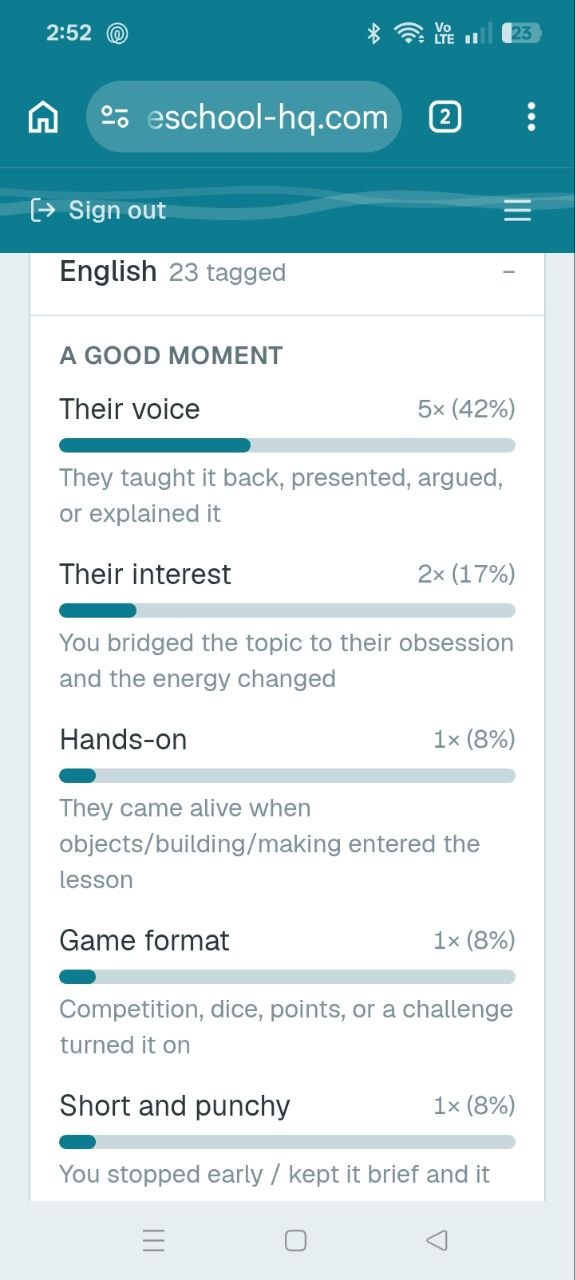
This is Sarah's English from the example account. Her most common good moment is Their voice, at 42% of the good moments tagged in English. She does her best work when she can explain, present or teach it back. One tagged lesson wouldn't tell you that. A pattern of them does.
The picture is different in each subject, which is the point. In Sarah's Science, Hands-on is half of her good moments.
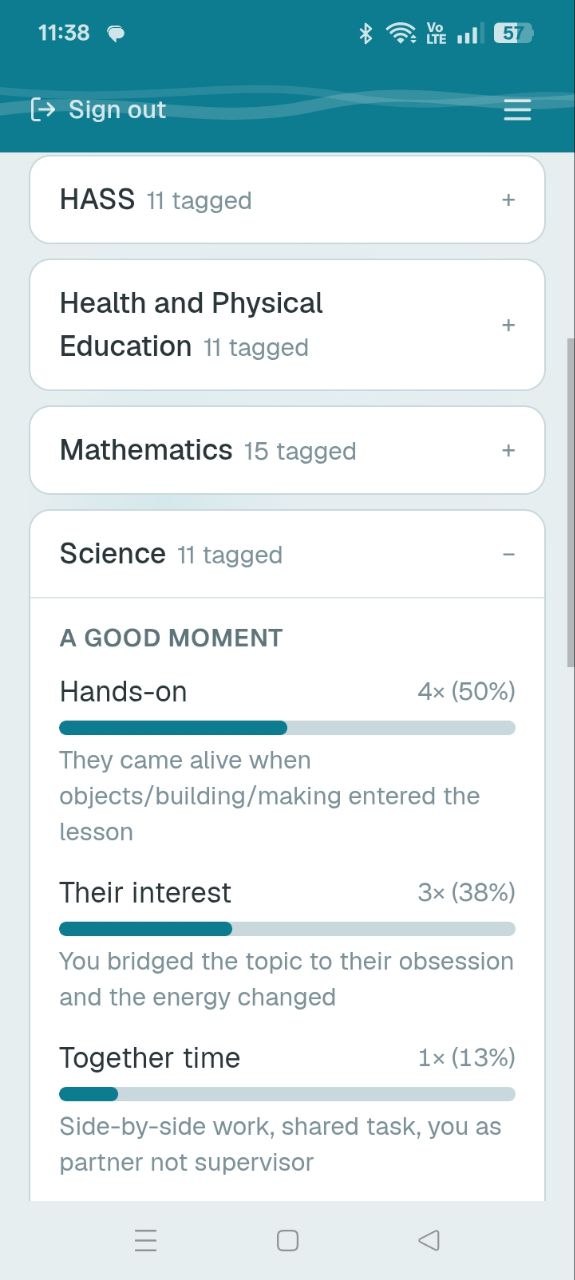
Knowing that, you can plan Monday's science with something to build, and plan English around her explaining it to someone.
When something isn't working
The second half of the page is for the harder days. Tap a "something to work through" pattern and you'll see the most likely cause, and a small experiment to try.
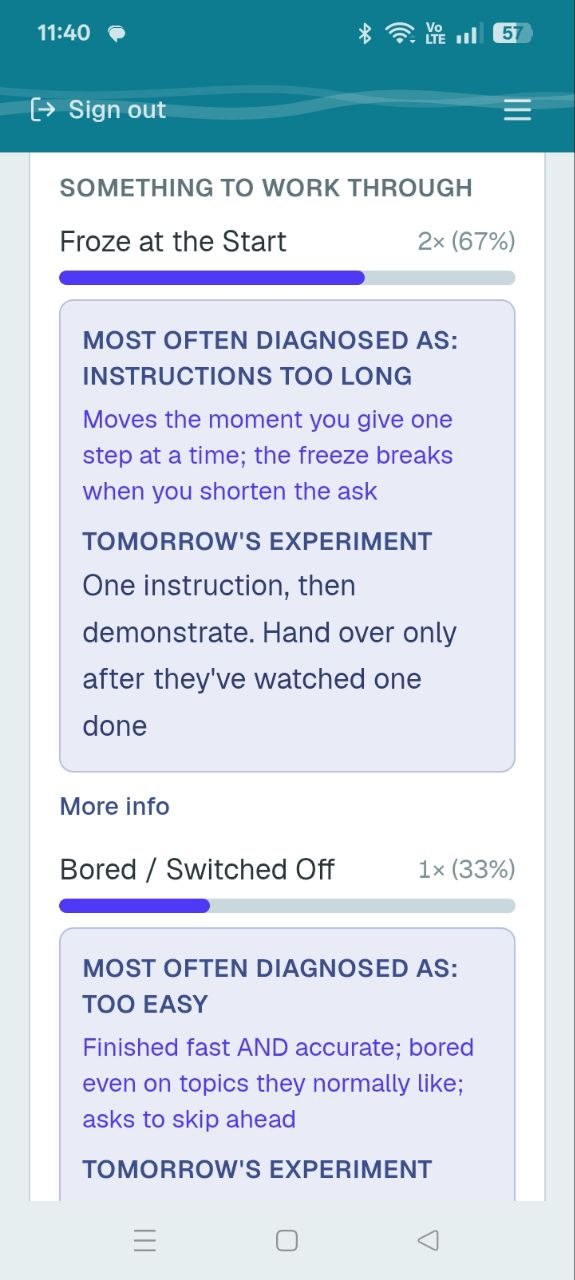
Each behaviour has four likely causes, with a short note on how to tell them apart. Take Froze at the start:
- Instructions too long: it moves the moment you give one step at a time.
- Doesn't know where to start: they ask "what do I do?" even after you've explained.
- Blank-page problem: fine with fill-in-the-blank, frozen by open tasks.
- Slow warmer-upper: the first task of the day is always like this, in any subject.
The app shows the cause that fits your tags best, along with Tomorrow's Experiment. For "instructions too long", it's: one instruction, then demonstrate, and hand over only after they've watched one done. A "More info" link opens further teaching strategies for that pattern.
That turns "he freezes sometimes" into something you can actually try tomorrow.
Reading it sensibly
- Give it a few weeks. Three tags are a hint. Thirty are a pattern.
- One bad Tuesday isn't a pattern. The tallies are most useful for what keeps coming back.
- It records observations, not diagnoses. The causes suggested are teaching explanations, not medical ones. If big reactions or the same struggle keep showing up for six weeks or more, it's worth getting more support, such as your GP.
- It's for you. Teaching Insights is for your own use. It is never sent to a registering authority.
Teaching Insights sits alongside the record of what you've covered. If you haven't seen it yet, here is how to glance at your week, how each subject adds up, and how to check your curriculum coverage.
If you'd like to find out what lights up your own child, you can get started here.